Irish EU plan includes UK in Made in Europe car rules without Chinese tariffs · SovereigntyNews.eu
Clean tech & EVs
Irish EU plan includes UK in Made in Europe car rules without Chinese tariffs
An Irish proposal would give the UK partner status under the EU's Industrial Acceleration Act, protecting cross-border car supply chains against Chinese competition.
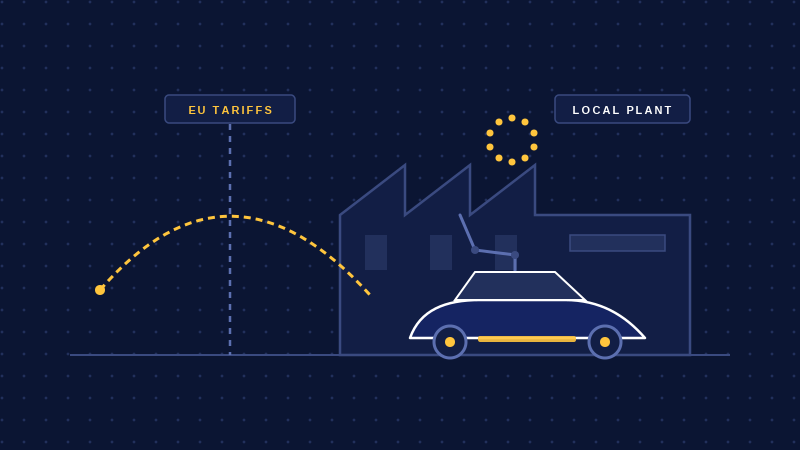
The Irish presidency of the Council of the European Union has proposed a compromise that includes the United Kingdom in the bloc's upcoming "Made in Europe" rules without requiring London to adopt EU tariffs on Chinese electric cars. The measure is designed to shield European supply chains from subsidised Chinese competition while avoiding disruption across the English Channel.[1]
The legislation, formally known as the Industrial Acceleration Act (IAA), seeks to bolster domestic manufacturing in automotive and clean energy technologies against low-cost competition, primarily from China. Under the fourth draft of the text, due to be reviewed by EU competition ministers on 3 December 2026, the European Economic Area, Switzerland, and the UK would receive "partner" status for automotive assembly.[1]
This partner status would grant reciprocal access to public subsidies for assembly plants and state procurement contracts for vehicle fleets. According to The Guardian, the arrangement would protect models assembled in the UK, such as the Mini at BMW's Oxford site and vehicles at Nissan's plant in Sunderland, allowing them to qualify as European.[1]
France initially sought to exclude the UK from the framework unless London dynamically aligned with EU import duties on Chinese vehicles. However, British Business Secretary Jonathan Reynolds insisted that the UK would not be forced into matching EU tariffs. The Society of Motor Manufacturers and Traders warned that penalising cross-border integration would harm both European and British manufacturers facing shared global pressures.[1]
“Having listened closely to all member states, the presidency has proposed a pragmatic and balanced way forward on the IAA to deliver for European competitiveness.”[1]
— Spokesperson for the Irish EU presidency
The compromise text also suggests granting component suppliers from Japan and South Korea access to European public support schemes and procurement. Meanwhile, pressure on European carmakers continues to mount. Chinese manufacturer BYD announced exclusive talks to buy Ineos Automotive's factory in Hambach, France, aiming to secure assembly capacity directly inside the EU before the new rules take effect.[1]
Why it matters for Europe
Europe faces a delicate balancing act as it seeks industrial sovereignty in electric vehicles: insulating its market against state-backed Chinese manufacturing without severing closely integrated regional supply chains with neighbours like the UK. At the same time, Chinese automakers are already bypassing import barriers by acquiring manufacturing sites within the EU.
Swiss transit operator VMCV has chosen Chinese manufacturer Yutong to supply up to 47 battery-electric buses and charging infrastructure. The deal highlights the growing presence of Chinese vehicle makers in European public transport fleets.
Chinese carmaker BYD is negotiating to buy an automotive plant in Hambach, France, from British firm Ineos to assemble electric cars inside the EU.
DE · ENGolem, Le Monde2 min readCNDEFRGB
Clean tech & EVs
What we don’t know yet
Whether EU member states, particularly France, will accept the compromise text during ministerial discussions on 3 December 2026.
The exact terms and timeline for BYD's potential purchase of the Hambach vehicle plant.
Sources
Written by AI from the sources below and usually published automatically, without prior review by an editor. Always check the sources for accuracy. Quotes from other languages are translated.
ENThe Guardian · United Kingdom · 24 November 2026 at 17:09
Consortium Holosolis aims to produce 10 million solar panels a year in France by 2029. However, the project depends on securing further financing and European regulatory support.
French manufacturer Forsee Power has introduced a new generation of its ZEN 8 commercial vehicle battery using lithium iron phosphate (LFP) cells. The modular system is produced in France in compliance with strict EU battery rules.